Repertoire


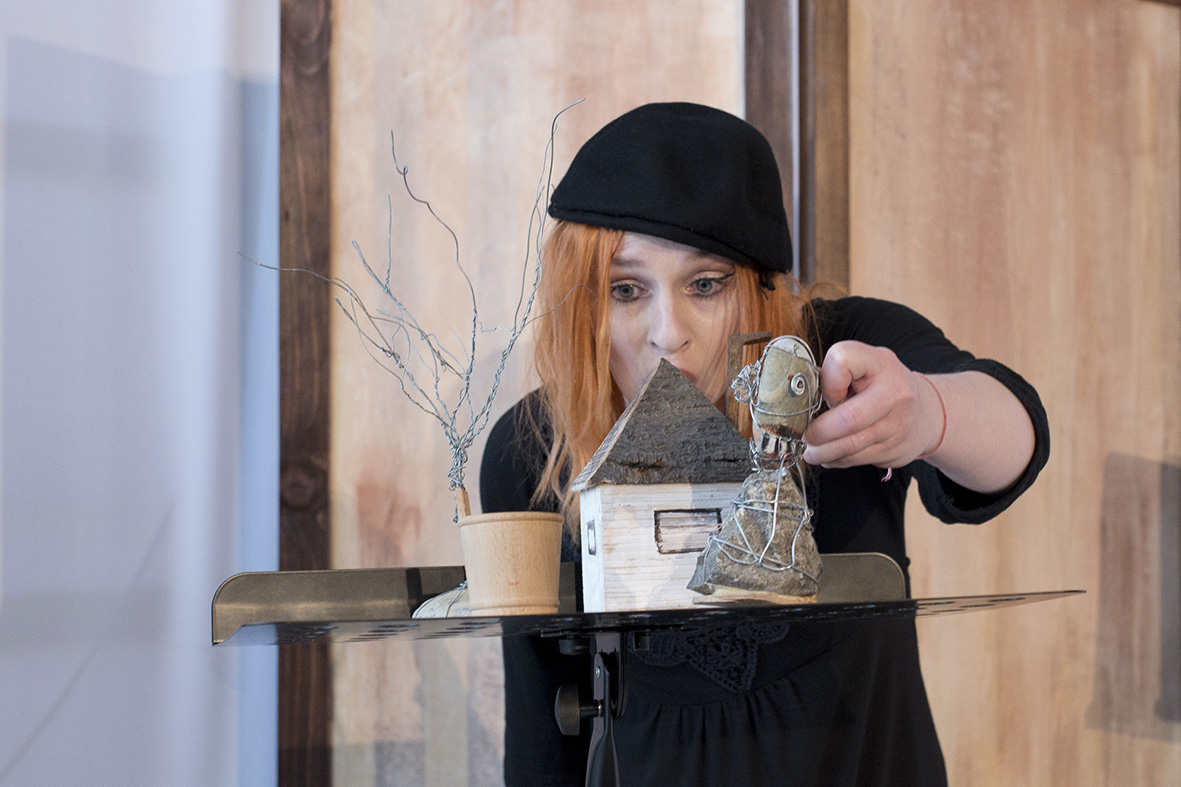


The Jewish tales
The third from a serie of foreign tales cycle Fairytale Geography.
Why should we talk to children about other cultures?
Today‘s television, radio, newspapers, and social media bring a vast ammount of information about the international situation, wars, migration crises, terrorist attacks, about cultural and religious differences. Children are perceptive to all of it. We are convinced that it is necessary for us to provide them with information that will counterbalance the barriers between the nations and cultures, among people – we want to do so in a simpler and less schematic way – through the way members of different nations and cultures are being portrayed by the entertainment industry. That is the significance of our Fairytale Geography project.
THE JEWISH TALES
Marián Pecko, director of the third episode of Fairytale Geography, has already come into contact with Jewish culture a few times. In Ostrava, while working on a play by Israel Horovitz Lebensraum, in Pardubice at The Juggler of Lublin. In Slovakia, Pecko as a director has interpreted the legendary Shop on the Main Street by Ladislava Grosman in DJZ Prešov. All of these plays are intended for adult audience.
„This time I tried to learn what adults and children talk about. And I have found out that it is not so simple, not at all. I have found out that in Hebrew there is no term for „fairytale“. There is no Jewish Fairy-teller, there is only some kind of interpreter. Jewish tales have never been there to capture the fleeting, only the lasting. Jews are not interested in imaginations but in truth. They have many myths and legends, but most of their heroes are historical figures.“
Director MP.
So let’s take a look at the results of our (non-)Fairytale search…
When I was little, I heard someone to use the term „Chelmer“. Back then I did not even fathom that somehwere in Poland there is a town called Chelm whose inhabitans, the Chelmers, are famous all around the world. Some consider them very stupid, some consider them wise, and others might even call them heroes. Every nation has their own „Wise-men“, every country has a town with comical stories and myths attached to it.
There are similar stories all over Europe: about inhabitants of the English town of Gotham, Greek Abdera, German Schild, French Clochmerle, or Slovak Kocúrkovo.
So Jews have their Chelm. And today we will tell you a story about some residents of this (extra)ordinary town…
Shalom aleikhem.
Peace be with you.
Issac Bashevis Singer (1902-1991)
Né Icek Hersz Zynger. Jewish American author of Polish origin, born in the village of Leoncin near Warsaw, who wrote in Yiddish. In 1935, 4 years before the German occupation of Poland, Singer emigrated to the United States of America. He died in Florida. Singer authored several books for children and young adults, novels, and autobiographical works. He did not shy away from, then shocking, taboo topics such as female homosexuality (Zeitl and Rickel, 1968), trans issues (Yentl and Yeshiva Boy, 1983) or the theme of Rabi possession (Zeidlus the Pope). In 1978, Singer received the Nobel Prize in Literature.
Menachem Kipnis (1878 – 1942)
was a prominent person in the cultural circles of Jewish Warsaw. He was an active member of the executive board of the Yiddish Literary Union, member of the Warsaw Jewish Music Society, co-founder of the Jewish Music Institute, member of the executive board of the Jewish Folk Ensemble and an initiator of large musical events. Kipnis started as a singer, later excelled as a music critic, expert, and collector of Yiddish music and Jewish folklore. After the offset of WW II, Kipnis did not attempt to flee Warsaw. With the help of several other musicians, he organised a Jewish symphonic orchestra that became the pride of Jewish Warsaw. Kipnis, luckily, had the honour to die from natural causes and was one of very few Jews burried at the Jewish cemetary.
Authors: Isaac Bashevis Singer, Menachem Kipnis
Scene design: Ivana Macková (guest)
Music: Róbert Mankovecký (guest)
Script, director: Marián Pecko
Cast: Ivana Kováčová, Filip Štrba
Public presentation: 14. 5. 2017
Openning show: 11. 6. 2017
Implemented with the financial help of Fond na podporu umenia (Foundation for Art Support).
